- Home
-
Products
-
Amphibious Multipurpose Dredger
- TEst
 Amphibious Multipurpose Dredger
The amphibious sand dredging vessel is a multi-functional dredging equipment that breaks through the terrain limitations of traditional sand dredging equipment and can freely switch operations in various environments such as land, shallow beaches, and water bodies. With its flexible adaptability and efficient operation performance, it has solved the industry pain points of traditional sand dredging vessels being unable to conduct operations on land and having low efficiency in shallow water areas.
More >> -
Bucket Wheel Dredger
- test
 Bucket Wheel Dredger
The bucket-wheel dredger is a large-scale specialized dredging equipment with a rotating bucket wheel as its core excavation component. It integrates excavation, transportation, and mud discharge functions. It is mainly used for water area sediment excavation, waterway dredging, and land reclamation by filling. It compensates for the shortcomings of traditional dredging equipment, such as low excavation efficiency and poor continuity. This promotes the development of dredging projects towards larger scale and higher efficiency.
More >> -
Chain Bucket Dredger
- test
 Chain Bucket Dredger
The chain bucket dredger is a medium-sized specialized dredging equipment that uses a chain to pull the bucket as its core excavation component, integrating excavation, transportation, and sorting functions. It is mainly used for sand and gravel extraction and sediment dredging operations in water bodies such as rivers, shallow seas, and beaches, and is widely applied in small and medium-sized water conservancy, construction sand extraction and other engineering fields.
More >> -
Cutter Suction Dredger
- test
 Cutter Suction Dredger
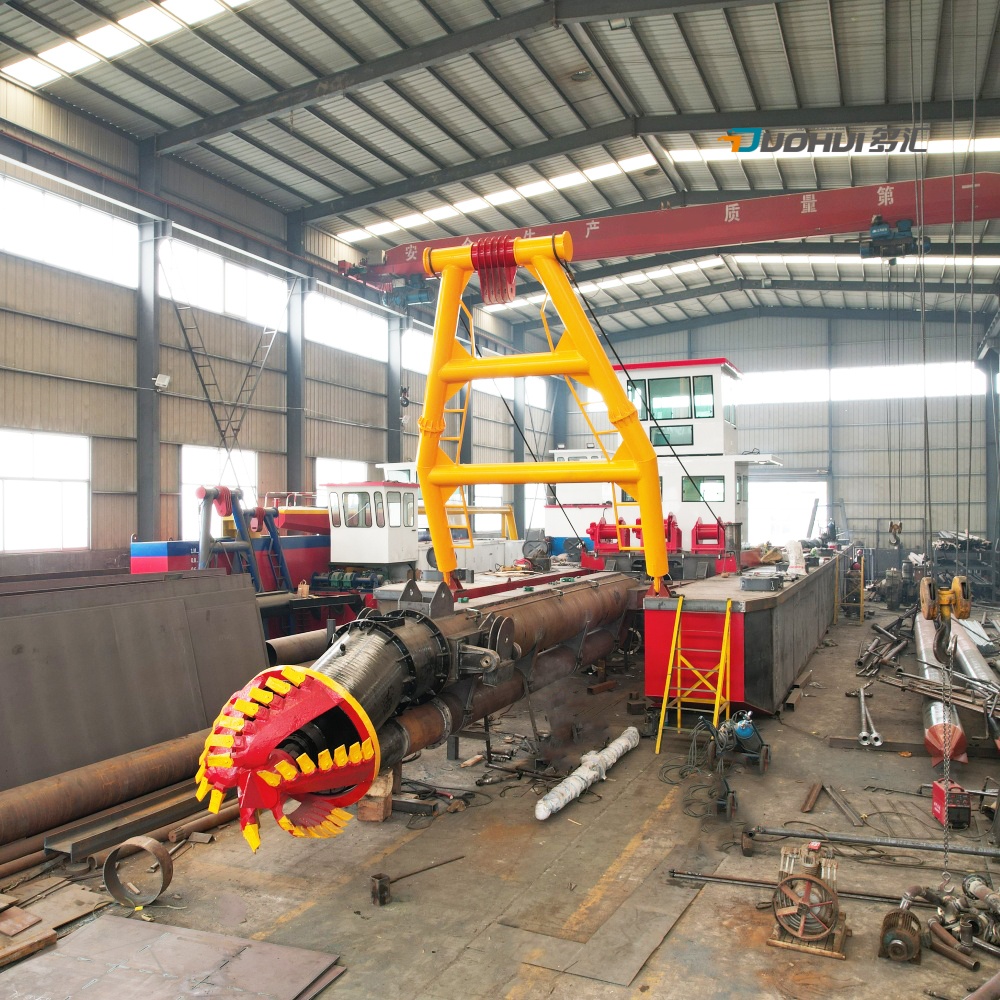
A suction dredger is a specialized dredging equipment with a rotating cutter as its core excavation component. It integrates excavation, loosening, and suction and discharge functions. The core principle is to use the cutter to cut the soil and the mud pump to suck and discharge the mud under negative pressure, enabling continuous "excavation - transportation" operations. It is widely used in large-scale water-related projects such as waterway dredging, land reclamation by dredging, river channel cleaning, and port construction.
More >> -
Drilling Pump Dredger
- test
 Drilling Pump Dredger
A drilling dredger is a specialized dredging equipment that integrates drilling, crushing, excavation, and suction and discharge functions. Its core consists of a drilling tool that penetrates hard soil or rock layers. It is combined with a crushing mechanism to break down hard soil masses, and then the excavated materials are transported to the designated area through the suction and discharge system, enabling precise dredging operations on deep and hard soil conditions.
More >> -
Jet Suction Dredger
- test
 Jet Suction Dredger
The jet suction dredger is a vessel that integrates the functions of impact, stirring, suction of sediment, and transportation. Its core mechanism is that a high-pressure water pump generates a high-pressure water flow to impact the bottom sediment, making it moist and disintegrate into slurry. Subsequently, through negative pressure, the slurry is sucked into the designated area by the suction pump, thereby enabling the dredging and silt removal operation in shallow water areas.
More >> -
Sand Dredger
- test
 Sand Dredger
A dredger is a specialized piece of equipment designed for extracting sand and gravel from water bodies and for dredging sediment. Depending on the differences in excavation principles, structural forms and operational scenarios, it can be classified into various types and is widely used in water-related projects such as river dredging, reservoir renovation, shallow beach development, construction sand extraction, and port maintenance.
More >> -
Suction Dredger
- test
 Suction Dredger
A suction dredger is a specialized sand extraction equipment that operates based on the core principle of "rotary cutting + suction + transportation". It integrates excavation, crushing, and suction and discharge functions. The core mechanism involves using a rotating cutter to cut the underwater sediment (or hard soil layer), combined with a negative pressure suction pump to form a slurry, and then transporting the slurry over long distances through pipelines to the designated area, achieving integrated continuous operations of sand extraction and dredging.
More >> -
Aquatic Weed Harvester
- test
 Aquatic Weed Harvester
The lawn mowing and cleaning vessel is a professional water area environmental protection and cleaning equipment. It adopts a unified operation mode of cutting, fishing, collecting and transporting, which can remove weeds on the water surface and underwater, and collect floating garbage. It is easy to operate, efficient in cleaning, and has wide adaptability. It is widely used in river channels, lakes and other areas, and can purify water quality, clear waterways, and contribute to the maintenance of water area ecology and navigation safety.
More >>
-
Amphibious Multipurpose Dredger
- News
- Services
- About Us
- Contact Us