The Global Sand Mining Landscape: Industrial Reality & Economic Paradigm
Sand is the second most consumed natural resource on Earth after fresh water, serving as the foundational building block of contemporary infrastructure. From structural concrete and land reclamation projects to asphalt batching, foundry castings, and industrial silicon manufacturing, the global appetite for marine and alluvial aggregates surpasses 50 billion metric tons annually. Within this massive supply chain, the suction dredger for sand mining represents the primary capital asset responsible for extracting underwater granular material from river deltas, estuaries, lakes, and coastal sea beds.
Historically, underwater sand extraction relied on inefficient mechanical rope-grab excavators or basic bucket elevators characterized by discontinuous batch harvesting, intensive mechanical wear, and high fuel consumption per dry ton extracted. As construction schedules accelerate and near-shore accessible deposits become depleted, the industrial sand harvesting sector has undergone a structural transition toward continuous hydraulic suction dredgers. Modern suction dredge vessels deliver continuous volumetric slurry output, transport material over kilometers without intermediate handling, and achieve unparalleled production economics.
Shifting from Mechanical to Continuous Hydraulic Extraction
The operational imperative in commercial aggregate production is reducing the levelized cost per cubic meter ($/m³). Mechanical dredging systems suffer from cyclical idle time during bucket hoisting, slewing, and discharge. Conversely, hydraulic suction dredgers synthesize excavation, vertical lifting, and horizontal pipeline logistics into an unbroken closed-loop workflow.
Whether operating as a pure suction rig, a jet suction platform, or a cutter suction dredger (CSD), suction technology utilizes centrifugal slurry pumping dynamics to create deep low-pressure zones at the suction mouth. Ambient atmospheric and hydrostatic water column pressures force fluidized bed particles into the suction pipe, yielding an uninterrupted flow of solid aggregates.
Hydro-Transport Production Formula
Q_s = Q_m × C_v = (π × D² / 4) × V_m × C_v
Where Q_s is solid sand production (m³/s), D is dredge pipe inner diameter, V_m is mean mixture velocity (typically 3.8 - 4.8 m/s), and C_v represents volumetric solids concentration (typically 18% - 32%).
Engineering Classifications: Selecting the Right Suction Dredger Configuration
Industrial sand extraction environments vary drastically based on geological consolidation, silt fraction, depth below water level, and environmental constraints. Selecting the correct suction dredge variant determines whether a mining enterprise achieves target return on investment or suffers catastrophic mechanical downtime.
1. Plain Suction Dredgers (Trailing or Stationary)
Plain suction dredgers operate without auxiliary mechanical cutting teeth. They depend exclusively on the natural angle of repose and the sheer fluid drag of inward rushing water to draw loose, uncompacted granular sands into the intake mouth. These vessels excel in free-flowing riverbeds and deep marine sand borrow pits where sediments lack cohesion. When extraction depth exceeds 20 meters, submerged dredge pumps installed directly on the suction ladder eliminate suction lift limitations, enabling sand extraction down to depths of 45 meters or more.
2. Water Jet Suction Dredgers (High-Pressure Hydraulic Disintegration)
When sand deposits exhibit mild cohesion, clay bonding, or high packing density, plain suction proves inadequate. Jet suction dredgers integrate high-pressure centrifugal clean-water pumps delivering fluid at 0.6 to 1.8 MPa through strategically oriented nozzles clustered around the suction head. These focused hydraulic needles fracture the inter-particle shear resistance of the compacted sandbank, fluidizing the mineral matrix into a dense slurry without requiring rotating cutter heads. Jet suction equipment minimizes maintenance expenses in abrasive silica environments by eliminating moving subsea parts.
3. Cutter Suction Dredgers (CSD) for Consolidated Aggregate Strata
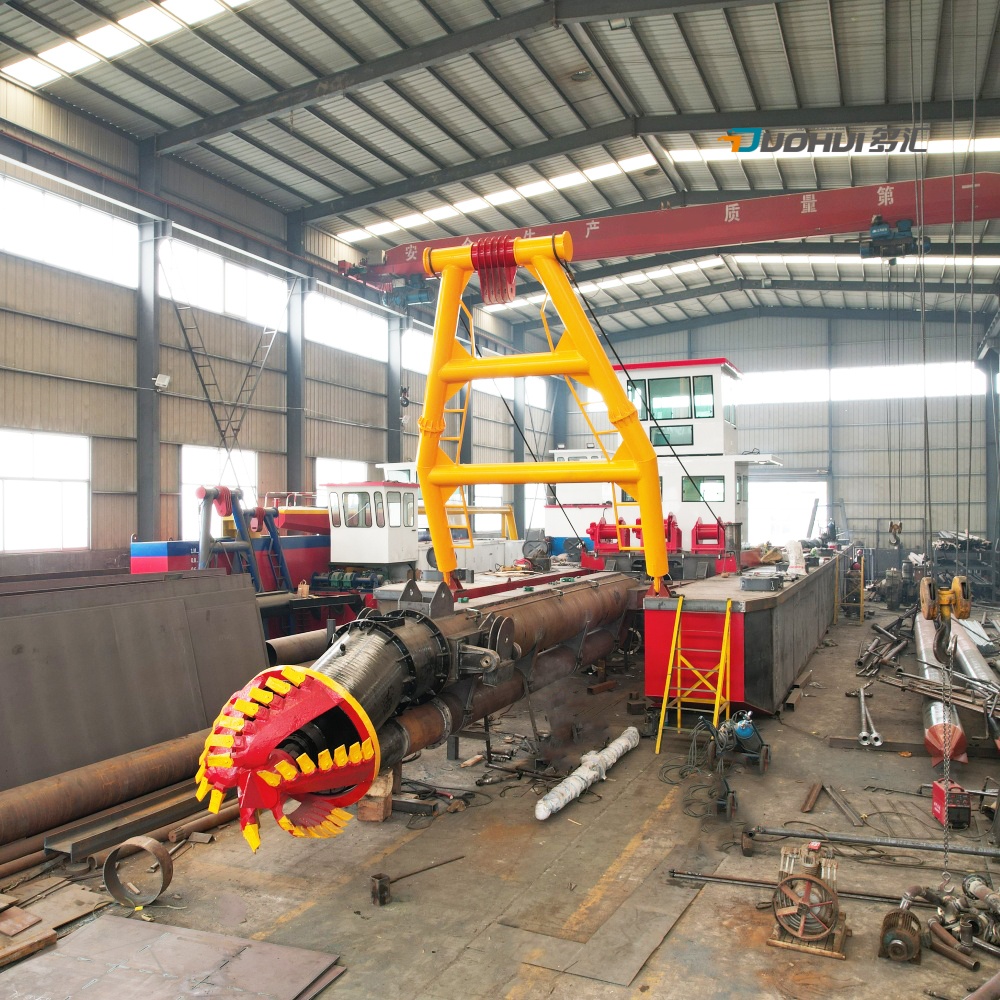
For alluvial deposits interbedded with hard clay seams, gravel matrices, or weathered sandstone crusts, the cutter suction dredger is the definitive industrial choice. Equipped with a heavy rotating cutter crown driven by hydraulic motors or variable-frequency electric drives, the cutter teeth physically slice and rake the aggregate bed toward the suction entrance. CSDs anchor via hydraulic spud poles and swing in wide arcs controlled by mooring winches, achieving millimetric extraction precision and uniform cut benches.
| Dredger Class |
Geological Suitability |
Max Depth (Standard) |
Solid Concentration (Cv) |
Abrasion Profile |
| Jet Suction Dredger |
Loose to semi-compact coarse sand |
15 m – 35 m |
20% – 32% |
Low (No rotating cutting heads) |
| Cutter Suction Dredger |
Compacted sand, clay, gravel, rock crusts |
8 m – 25 m |
15% – 28% |
Moderate to High (Tooth/Crown wear) |
| Bucket Wheel / Bucket Chain |
Sticky clay, heavy gravel mixtures |
6 m – 18 m |
Continuous Mechanical |
High mechanical wear on chain/pins |
| Amphibious Multipurpose |
Shallow deltas, tailing ponds, wetlands |
3 m – 6 m |
12% – 22% |
Low to Moderate (Versatile work tools) |
In-Depth Scenario Analysis: Primary Commercial Mining Arenas
Scenario A: Riverine Aggregate Extraction & Flood Channel Maintenance
In dynamic river systems such as the Mekong, Yangtze, Pearl, and Mississippi basins, sand mining must simultaneously satisfy commercial aggregate yield while maintaining hydrological equilibrium. Riverbeds naturally accumulate silt, sand, and gravel carried from upstream catchments. Unregulated accumulation reduces hydraulic conveyance capacity, exacerbating flood risks during seasonal monsoons.
Suction dredgers deployed in riverine sand mining execute a dual objective: removing sandbars to maintain safe commercial navigation channels while delivering high-grade river sand to ready-mix concrete batching terminals. By utilizing precise positioning systems, dredgers selectively harvest aggregate seams without scouring structural bridge piers or disturbing natural riverbank stability.
Scenario B: Coastal Sand Borrowing & Island Reclamation Megaprojects
Offshore infrastructure developments, coastal defense reinforcements, and artificial island reclamations demand unprecedented volumes of sand—often tens of millions of cubic meters within strict contract deadlines. In these offshore sand borrow pits, heavy sea swells, tidal currents, and saline corrosion create harsh operating conditions.
Modern coastal suction dredgers employ reinforced split-hull architecture, pontoon-stabilized outriggers, and heavy-duty spud carrier systems. Submerged ladder pumps allow continuous harvesting despite deep oceanic swells, transferring the dredged slurry directly into trailing suction hopper barges or pumping through long-distance submerged steel/HDPE discharge pipelines equipped with booster pump stations.
Scenario C: High-Purity Silica Sand Mining for Industrial Glass & Solar Photovoltaics
Industrial silica sand (SiO₂ > 99.5%) is a vital precursor for float glass, photovoltaic solar cover plates, semiconductor silicon, and ceramic foundry molds. Silica extraction sites—frequently located in inland lake deposits, paleo-dunes, or open quarry pits inundated by groundwater—present distinct operational hurdles.
Silica sand is exceptionally abrasive, possessing a Mohs hardness of 7. Conventional metallic components degrade rapidly under high-velocity slurry friction. For silica mining, suction dredgers integrate specialized chromium-molybdenum alloy dredge pumps (Cr26/Cr28), ceramic composite impellers, and ultra-high-molecular-weight polyethylene (UHMWPE) discharge pipes. Furthermore, hydrocyclone desliming circuits mounted directly on auxiliary processing barges separate organic contaminants and clay slimes at the point of extraction.
Scenario D: Integrated Heavy Mineral Sands & Alluvial Placer Mining
In beach placer and alluvial deposits across Africa, Southeast Asia, and Australia, sand deposits carry significant economic concentrations of heavy minerals, including ilmenite, rutile, zircon, monazite, and alluvial gold. In these specialized placer mining operations, suction dredgers act as the wet-mining excavator feeding floating gravity concentration plants.
The suction dredger delivers a homogenized, constant slurry stream into revolving trommels, vibrating screens, and spirals. Coarse tailings and washed silica sand are cycloned and redeposited systematically behind the mining face, allowing concurrent backfilling and environmental rehabilitation of mined estuaries.
Technological Trends Shaping the Next Era of Suction Dredging
Driven by strict environmental oversight, carbon reduction commitments, and tightening labor markets, the suction dredging industry is undergoing a digital and ecological transformation:
1. AI-Driven Autopilot & Dredging Telemetry
Traditional dredging efficiency relied entirely on the intuition of veteran dredge masters reading analog vacuum gauges. Today, integrated SCADA systems and machine learning algorithms monitor slurry velocity, discharge pressure, engine torque, and swing winch tension thousands of times per second.
When the system detects rising vacuum levels indicating intake blockage or impending cavitation, it automatically modulates the cutter head advance rate and activates jetting dilution valves. This real-time automation elevates daily aggregate production consistency by 15% to 25% while shielding drivetrains from catastrophic operator error.
2. Environmental Sediment Plume Mitigation
Environmental regulators worldwide mandate strict controls on water turbidity caused by dredge overflow and suction disturbance, which can impair aquatic ecosystems. Eco-friendly suction heads engineered with hydrodynamic containment skirts confine high-velocity eddy currents, directing ambient water inward toward the suction pipe rather than dispersing fines into the water column.
Additionally, green valves installed in hopper overflow lines prevent air entrainment in discarded fines, causing residual silt to descend directly to the seabed rather than staying suspended in upper photic layers.
3. Electrification & Hybrid Green Drivetrains
As maritime emission mandates (IMO Tier III and EU Stage V) take effect across global waterways, dredge propulsion and pumping drives are shifting toward electric and hybrid architectures. Shore-powered electric dredgers (utilizing high-voltage submarine trailing cables) achieve zero direct emissions at urban river improvement and aggregate mining sites. For offshore projects, variable-speed diesel-electric systems coupled with lithium-iron battery banks buffer high peak loads caused by cutter head shocks, trimming fuel consumption by 18% to 30% compared to legacy direct-drive diesel engines.
Capital Expenditure (CAPEX) vs. Operational Efficiency (OPEX): The Economic Equation
Investing in a sand mining suction dredger requires balancing initial capital acquisition against ongoing operational wear and lifecycle costs. Because sand mining is a high-volume, low-margin bulk commodity business, small reductions in operating expenses yield compounding returns over multi-year extraction concessions.
High-efficiency suction dredgers optimize OPEX through three core levers:
-
Specific Fuel Consumption per Ton: Modern tier-rated internal combustion engines and matched centrifugal pump curves minimize kilowatt-hours consumed per dry metric ton of sand discharged.
-
Wear Component Longevity: Advanced slurry metallurgy (ASTM A532 Class III Type A) doubles the run-time intervals between pump casing replacements and impeller refurbishments, avoiding costly operational standstills.
-
Continuous Discharge Logistics: Pumping directly to on-shore processing stockpiles through floating pipelines eliminates the tugboat, barge, and rehandling costs typical of mechanical clamshell operations.

 Amphibious Multipurpose Dredger
 Bucket Wheel Dredger
 Chain Bucket Dredger
 Cutter Suction Dredger
 Drilling Pump Dredger
 Jet Suction Dredger
 Sand Dredger
 Suction Dredger
 Aquatic Weed Harvester